MAY CONTAIN SPOILERS
A place for questions about the intended interpretation/application of rules on cards, Photos are probably best if you have the time/patience. Minimally, state the card’s name if it has one, its type (e.g., “Loot” or “Jungle Denizen”) and give a summary of the text/icon you’re asking about.
1 Like
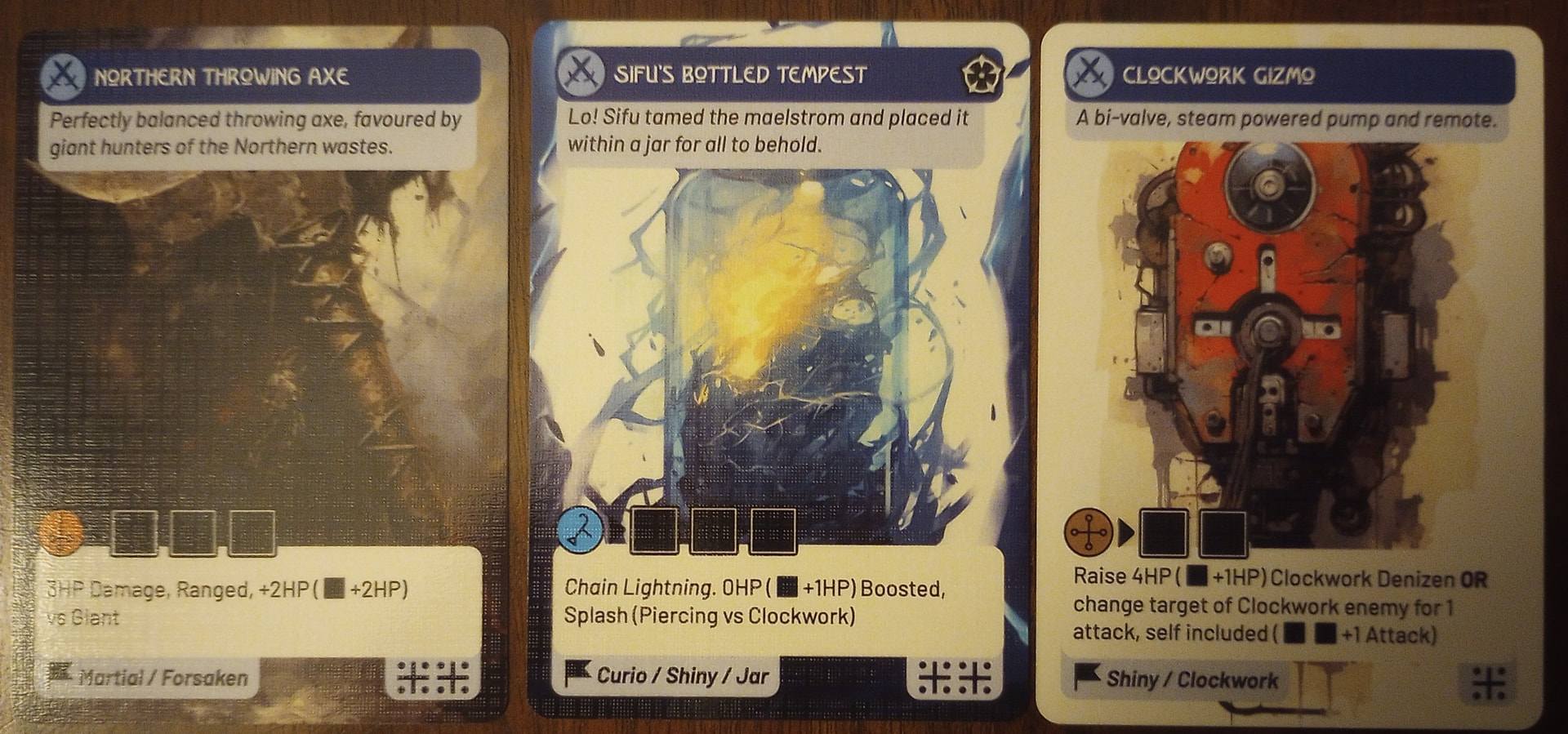
Sifu’s Bottled Tempest (Loot card with sun icon)
What does it do?
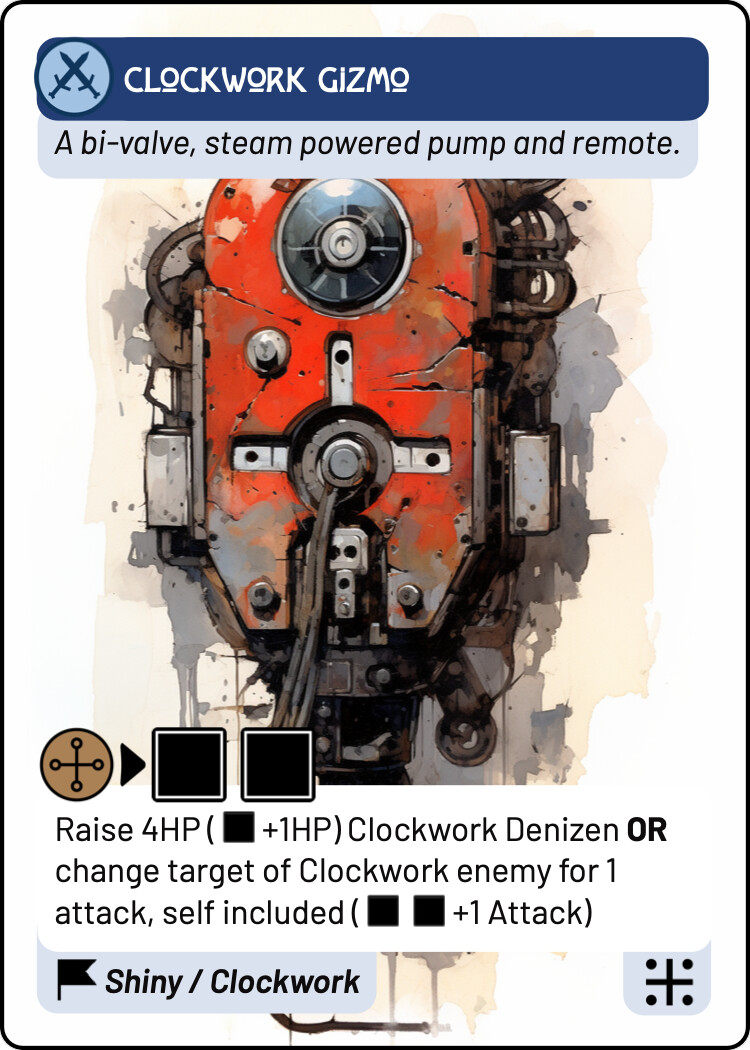
The introductory text “Chain Lightning” suggests it is an attack that deals damage. I might have thought that all cards with the crossed swords icon at top-left deal damage, but Clockwork Gizmo shows this is not the case, since (according to Glossary v0.13 p.3) “Raise(x)” means to Increase HP… by x, I would guess, although the Glossary does not say that. Also the text on Gizmo doesn’t follow the (x) format.
Still, I might think it does damage… but then “Northern Throwing Axe” suggests that when a card deals 3 HP of damage, it will say “damage,” which Sifu does not say.
In general I think it does damage (0 unless you have mastery, though always with a boost). But this small tableau indicates that the text around damage (and Raising) has not really been standardized. I suspect other cards may raise similar questions.
1 Like
The item cards are some of the earliest cards. They may have some language inconsistencies. Ideally an item description should have an action name, a unique ability and some mechanism for enhancement if you have applied mastery (aka experience).
I have suggested some updated wording for comparison – let me know if it helps at all.
The tricky and potentially rule breaking nature of the unique abilities makes them vulnerable to misinterpretation – feedback on all item cards is welcome.
Specific examples with commentary. All our combat items so can be used at any time in a combat round (although only one item per round).
Northern Throwing Axe
Toss. 3HP damage, Ranged. +2HP (+2HP) vs Giant.
Discard for 3HP of ranged damage on any enemy. Ranged is important when it comes to guarded enemies. If the enemy has the Giant keyword, add an extra +2HP damage. For every mastery cube, an additional +2HP to a Giant enemy.
Useful in a pinch. Deadly against a giant when levelled up.
Note, mastery track memory is violence.
Sifu’s Bottled Tempest
Chain lightning. 0HP damage (
Ah, an artefact of the legendary elementalist Sifu! Discard for 0HP damage but add Boost damage (ie. flip a loot card and look for 0-3 boost icons) for each enemy. Splash just means area effect, and all enemies in play will be affected. If the enemy has the Clockwork keyword, the damage is Piercing. Clockwork denizens are often vulnerable to electricity. For every mastery cube, add +1HP damage to all enemies.
Generally useful for softening up the enemy, especially if levelled up and you have a group of enemies to fight.
Note, mastery track memory is magus.
Clockwork Gizmo
Fix. Raise 4HP (
Discard to raise the hp of any clockwork denizen in the hero tableau. Note, raise is different to heal in that a companion can be temporarily raised above their max HP but can only heal up to their max hp. The hero can never be raised above their max HP, but could benefit from the healing affects of a raise ability – no Clockwork hero’s just yet.
OR
Remote control a Clockwork enemy to perform an attack; which could include attacking itself. If you have two mastery cubes, you may attack again with the enemy.
A few other thoughts; if the enemy was “ready” you could activate a power in the attack, exhausting the enemy, else you’d have to settle for its base attack. No clockwork denizens in play, then not a very useful item – unless you can parley with it.
Note, mastery track memory is tinker.
1 Like
As a worked example incorporating a location encounter from the tutorial… imagine you had the Clockwork Gizmo and Tic Toc Tick…
Note, this is the tutorial version of this location encounter. And if you are following the recommendations you would not have access to the non-starter loot card, but its a fun scenario to consider.
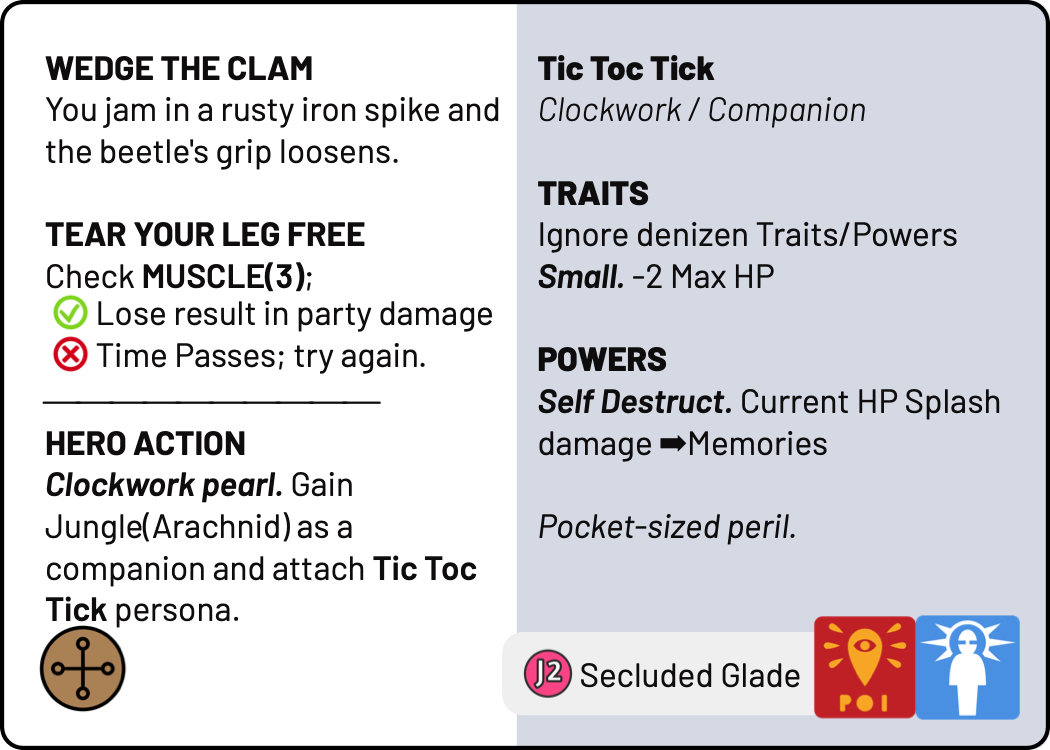
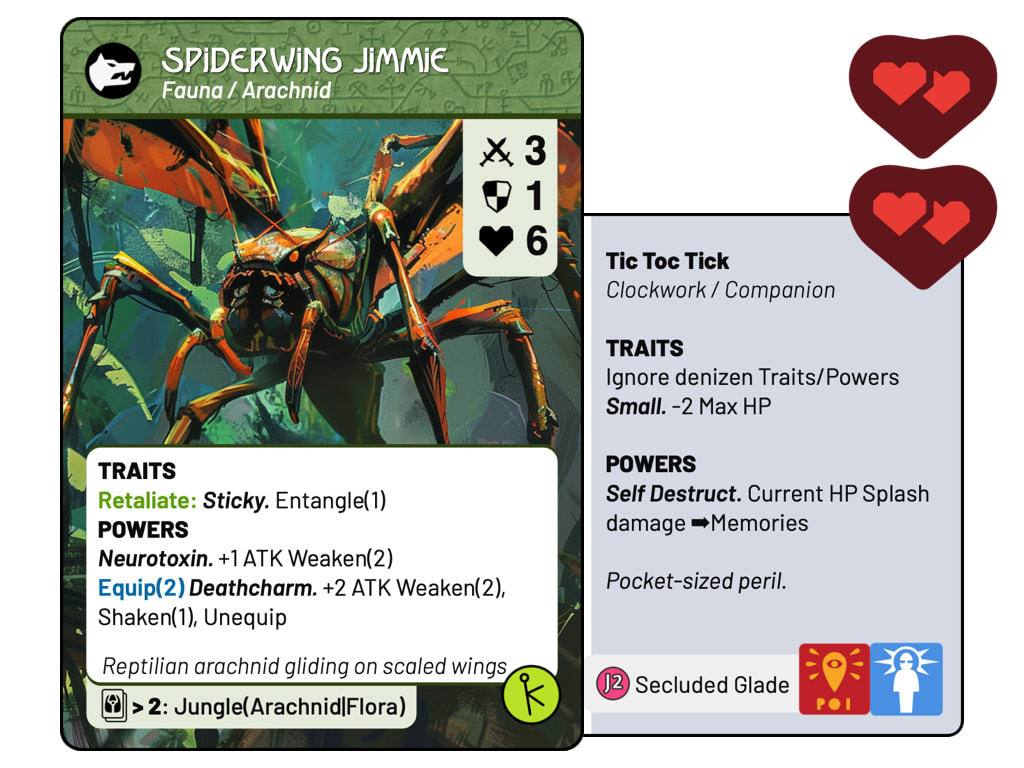
Typically Tic Toc Tick would start life with a max HP of 4. But if you could add a couple of mastery cubes to the Gizmo, you could raise the clockwork spiderwing to 10HP (4+4+2) mid-battle and send him in to self-destruct for 10HP damage to every enemy combatant!
This would make short work of the tutorial finale, destroying almost the entire Maboon Court in a single fiery action.
The re-writes help clarify the cards I posted, and I think the key was just that the word “damage” was missing from Sifu’s Bottled Tempest. This isn’t a staggering omission by any means and I might have guessed (indeed, I did!). But the economy of language and abbreviations in the game is generally so intentional that the uninitiated has to ask to be sure. 
The Tic Toc Tick example is interesting… but a little confusing.
- For a moment I thought that combat item cards were single use, but I guess that’s wrong, they can be re-used but can only be used once per combat round. So is the idea that I can use Gizmo one round to bump the clockwork spiderwing +4HP, and then (because the “OR” does not allow me to do it simultaneously) the next round I can use the Gizmo to re-set the spiderwing’s target so that it damages my enemies rather than me? (By default it would target me, right?)
-
And then, lastly, I don’t fully understand the “🠲 memories” at the end. Is it just a reminder to put the card in your memory pile once its defeated? That black arrow appears to be a rogue icon not included in the current Icon Glossary.
1 Like
All item cards are consumable. They are discarded when their power takes effect. They only work one time.
1 Like
In that case:
- Revise the text on RB 34, §“Using Items” for clarity. It currently reads: “You may activate a Quick or Combat item card once per combat round.”
and - I do not understand the Tic Toc Tick example, since I do not understand how I can use the Gizmo to both bump the spiderwing’s HP and set it to target my enemies.
1 Like
No. The OR means you can do one or the other, then discard the card. ie. one use only.
If you were fighting a denizen with the Clockwork keyword then you could have alternatively used the item card to force the enemy to attack another enemy target of your choice.. i guess kind of hacking the Clockwork creature and taking control of it.
As Tic Toc Tick is your companion and not an enemy the card could never be used in this way in this scenario.
Arrow symbol is missing from the glossary!
The symbol abbreviates the phrase “move the card to Memories” – which you’ll find is used in a lot of encounter cards to signify the encounter card is removed from play.
In this instance it means the persona and its attached card should be put in the Memory discard – Tic Toc Tick has blown up and is no more.
1 Like
Loot items are defined as consumables that are discarded for their ability. In the combat section I’ll update the statement to reinforce this.
You may discard a single Quick or Combat item for its action once per combat round.
1 Like