I have now gotten though most of the first 4 rounds of the Learn to Play, and I am providing the detailed feedback I have for now since I may not have as much time to learn/play until next weekend.
I think I am reaching the conclusion that the “Learn to Play” file would be better named as an “extended gameplay example with some expert commentary.” Its utility as a rules teaching device would be greatly improved if it were littered with explicit references (page numbers) to where relevant rules are covered in the rulebook. Without this, the commentary too frequently comes across as “this is how an expert would summarize it, having already internalized the rules" and not as “here is how you, the uninitiated, should be internalizing the rulebook.”
The page numbers will be essential, as the Rulebook’s TOC is not very skimmable and the Glossary often fails to serve as an effective intermediary. If I were not able to CTRL+F on a digital version of the rulebook, I would be moving much slower using the physical copy I printed.
While I wish it were faster going, I lay a lot of it on my own hangups, and I am beginning to understand how the game’s design will come together, and I am intrigued. I look forward to returning soon, and I will keep my eye out for any revised reference materials that might evolve in the interim.
“Peril Event. The jungle denizen on the peril track has 5 Time so there is nothing to do here.” (LTP 5).
This terse comment is quite opaque for the uninitiated. Having spent some time trying to puzzle it out, I think it conflates two things that are kept distinct in Rulebook v0.13: (a) the “review the peril track for new encounters” moment at the start of a Peril phase, which is always relevant in every quest, and (b) the ensuing check for “Peril Events,” which the Rulebook says applies only to Sagas.
If the Rulebook is correct and there are no Peril Events in the Learn to Play (since it is a Vignette, not a Saga), then (i) Every subsection in the LTP that is currently titled “Peril Events” has been mis-titled and might be better titled “Review Peril track”, but (ii) a nod to Peril Events might be maintained in the LTP text, since the uninitiated should be told to keep them in mind “in future games.”
Alternatively, perhaps the Rulebook (and the player aid cards, and the quick reference) are outdated, and an “encounter arising from the peril track” is now regarded as one type of “Peril Event.” In that case these references must be aligned to match the LTP.
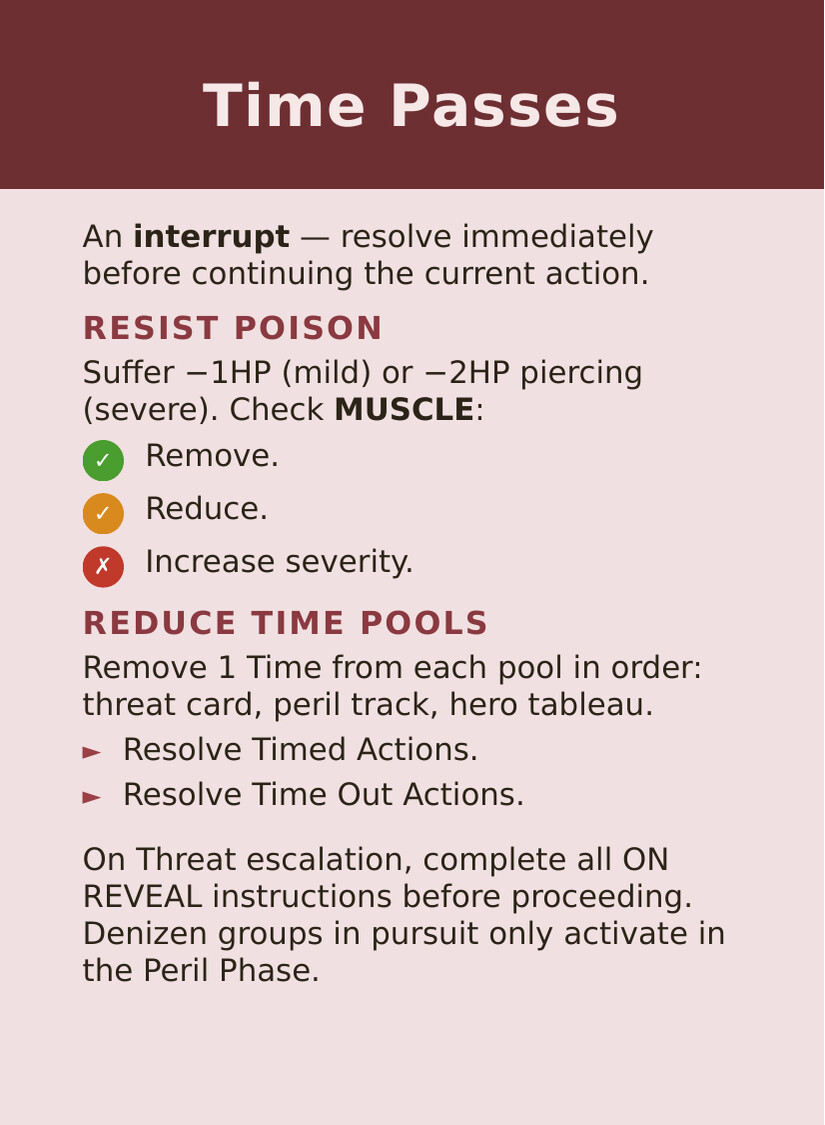
“move left to right along the peril track” removing tokens (LTP 5’s explanation of “Time Passes,” bottom-right)
The inset on LTP5 shows the first “Threat” card of the Vignette to the left of the Jungle Denizen Card. But the setup inset on LTP 4 does not include the Threat card in the Peril track. The reader should thus be told on LTP 5 to “remove a token from the active threat card if it has any, and then proceed left to right across the peril track…”
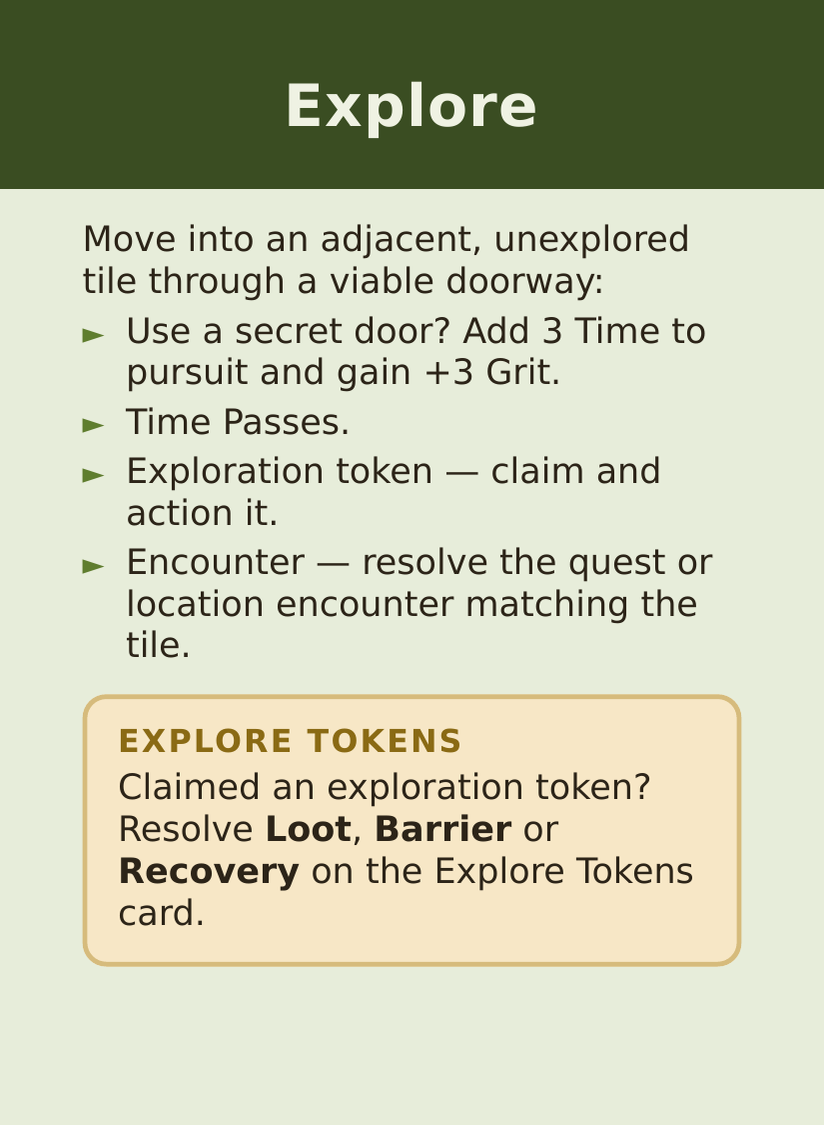
LTP 5’s explanation of “Exploration Tokens” makes a note about Barriers, even though they have been removed from the Learn to Play. I think a tutorial ought to include such considerations, but ideally they might be flagged for attention “in future games,” either by using such a phrase in prose, or perhaps using a special font/color/format.
In addition, LTP’s explanation of Exploration Tokens ends with a note about discarding them. Left unclear: are discarded Exploration Tokens returned to the draw pile, or removed from the game (and if removed, for what duration - this Quest? The whole Vignette?)
LTP 6, top-right, is the place to explain to the uninitiated how “party damage” works – a phrase that appears nowhere in the rulebook, or Glossary, though the Glossary entry for “Party” defines it as “damage distributed evenly amongst hero and companions.” The uninitiated who track this information down are left with a puzzle – why is no damage assigned to the Urchin in the LTP example?
(I think it’s because they’re a Malediction, which LTP 2 explained as “a special quest given card that cannot be targeted or lost” – i.e., an exception to the rule about how party damage impacts companions. If that’s right, this is also the place to explain to the uninitiated how Keyword priority is intended to work: from the LTP I infer that in “Malediction / Companion” the former nullifies the latter.)
LTP 8, top-left, introduces the reader to a “Peril Choice” (which in this instance offers no choice). This is now the third critical game phase/concept the uninitiated have encountered of the form “Peril X”, coming after Peril Events and the Peril Track. The Event/Track are (as seen above) so closely related in the order of gameplay that they might even be confused for each other, which arguably warrants associating them via the “Peril” prefix (though they still ought to be distinguished). By contrast a Peril Choice seems to be a completely unrelated interrupt, occurring at a completely unrelated phase of gameplay. I am not certain that the “Peril” prefix is used to its best effect here.
LTP 8, the right column works through the commentator’s thought process on whether or not to enter combat.
For the uninitiated, it is simply not clear how the commentator determines that the Hero should, after all, Enter the Fray. The Encounter doesn’t say they should, but the LTP commentary suggests that since we can’t Parley with the spider, we are forced to Enter the Fray for an unspecified reason. Turning to the Glossary for aid doesn’t help on its own, since the entry or “Enter the Fray” doesn’t specify how it is that one is caused to Enter the Fray. CTRL+Fing on the Rulebook doesn’t help, as the section on “Spawning Denizens” on RB 30 says only: “3. Reveal the denizen (turn face up) and Parley, unless you have been instructed to enter the fray.” The next RB section on Parley only explains when you may Parley and what that means – it contains no rule stating that if you cannot Parley, then you must engage in combat (even if the Encounter doesn’t say so).
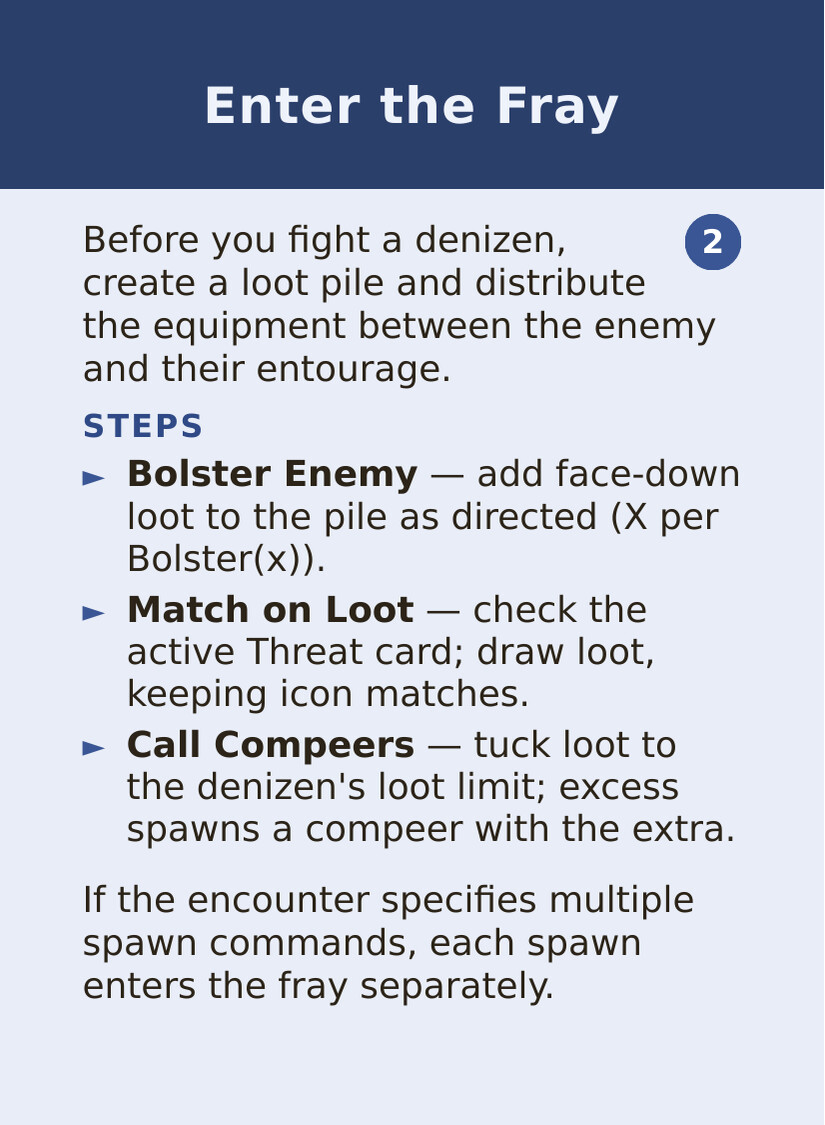
“Neither the encounter nor the spiderwing denizen have a Bolster command so we only need to draw and match the loot icon.” (LTP9, top-left).
Far too quick for the uninitiated as is, but would become incredibly useful if the reader were told that this is a terse summary of interpreting and applying the instructions on RB32-33 (for how to Bolster Enemy, Match on Loot deck draw, and Call Compeers).
“Unless stated otherwise, all gear confers a “bonus result” for defence rolls.” (LTP 9, bottom-right)
The relevant keyword that might allow the player to track down the source of this ruling is “armour,” not “gear,” though the Glossary will fail as a go-between as it contains only an entry for the stat, ARM. CTRL+F allows me to say that this rule seems to be stated in a single sentence on RB 35. I suggest that the Glossary entry for ARM should be revised to note this important effect. I suggest that the LTP should be revised to explain that what we are going here is skimming the Hero Tableau looking for ARM mods on any cards.
“The Spiderwing has a base attack of 3 and is in the “ready state”. The enemy will activate the highest power available. As it has a single loot card ie. Equip(1), we activate its Proboscis attack for 4HP (Base 3 ATK +1ATK).” (LTP 9-10).
Regarding the first sentence: The uninitiated have not previously been told that the Spiderwing is ready. The Rulebook does not explain that denizens spawn ready. The only example of something being “ready” that the LTP has covered so far is the Hero, who got a special token in setup (though the Rulebook did not cover that). The Glossary offers minimal aid, since it defines “ready” only as a card state, which doesn’t cover the one known case of the Hero’s ready token.
Regarding the final sentence, the reasoning is opaque until the reader comes to understand that we are now thinking through the rules for “Equipped abilities” on RB 28-29. (Again, page numbers are critical, since the LTP covers rules in a different sequence than RB).